

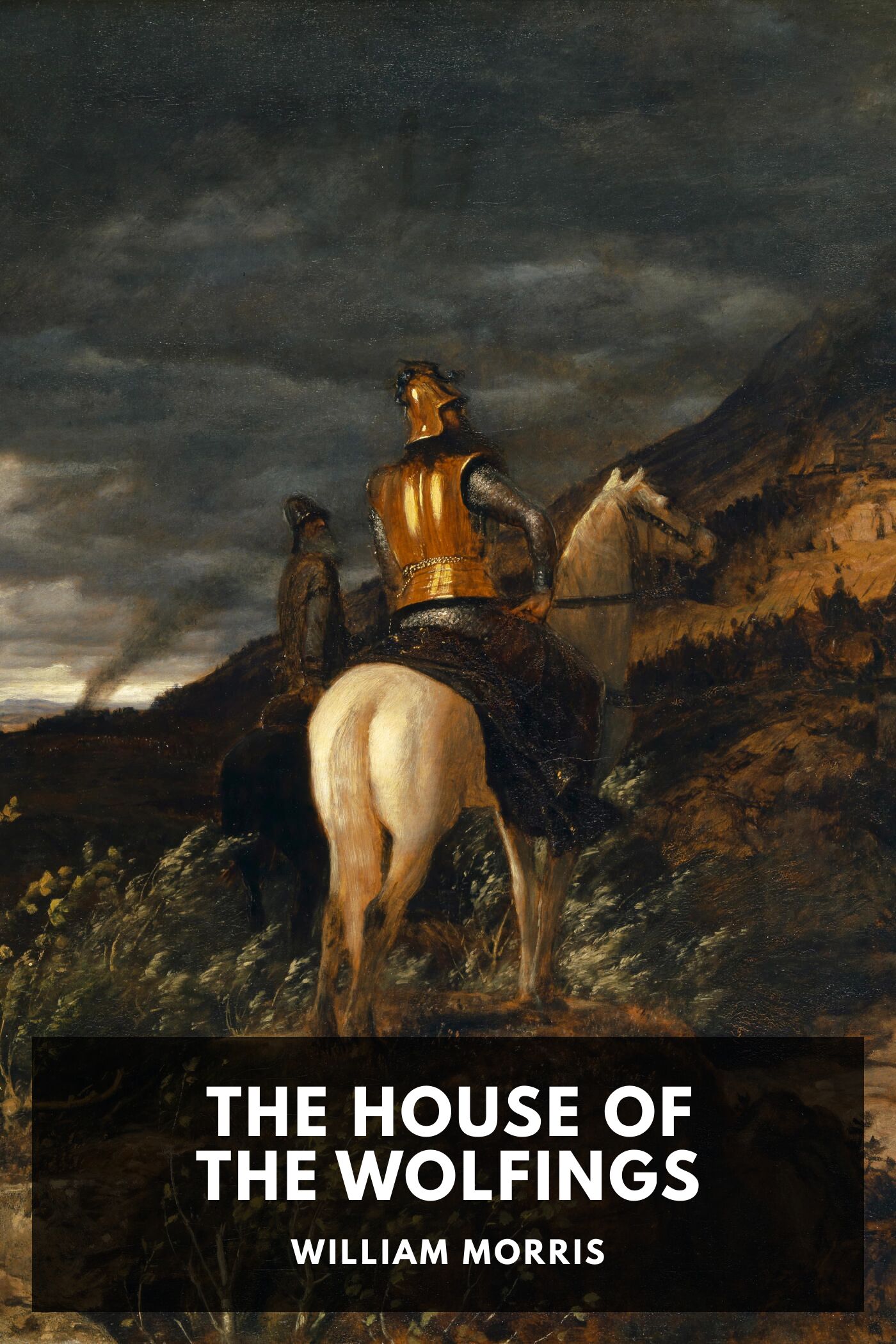
About this book
The House of the Wolfings tells the tale of a band of German Goths living in a wood they call the Mark. Their lives are idyllic until the long shadow of the Roman Empire threatens the peace in their land. Thiodolf, the leader of the Wolfings and a descendant of the ancient gods, must rally the surrounding tribes to defend their home and way of life.
Like much of Morris’s work, The House of the Wolfings is written in a purposefully archaic prose style, with significant portions of the dialog presented in verse. His goal was to explore the language and atmosphere of the medieval ages that so fascinated him, and the result is a uniquely rich and evocative narrative.
Morris also uses the contrast of the content and agrarian Goths with the violent and rapacious city-dwelling Romans to invoke one of his favorite themes: socialism. Our heroes are happy to live in an egalitarian society, with men and women valued equally, and close to the land and tradition. Meanwhile, the Roman invaders, unhappy in their modern lifestyle, seek personal glory and ever more booty, leading to nothing but destruction.
The novel, as a work grounded in reality but with an aspect of the magical or supernatural, is one of the forefathers of modern fantasy fiction. Indeed, The House of the Wolfings was a direct inspiration to J. R. R. Tolkien, who, acknowledging such in a 1960s letter, drew from it concepts as diverse as mysterious dwarves who are talented armorers, to tribes of Goths reminiscent of Tolkien’s Rohan, to a deep forest named Mirkwood.
Book Details
- Print length
- 309 pages
- Language
- English
- Publisher
- Standard Ebooks
- Publication date
- November 27, 2023
The House of the Wolfings
William MorrisMore from William Morris

More from Fantasy

Alice’s Adventures in Wonderland
Lewis Carroll

The King in Yellow
Robert W. Chambers

The Man Who Was Thursday
G. K. Chesterton

Thuvia, Maid of Mars
Edgar Rice Burroughs

The Wonderful Wizard of Oz
L. Frank Baum

A Midsummer Night’s Dream
William Shakespeare

Short Fiction
H. P. Lovecraft

Gulliver’s Travels
Jonathan Swift

Beowulf
Anonymous

A Connecticut Yankee in King Arthur’s Court
Mark Twain