

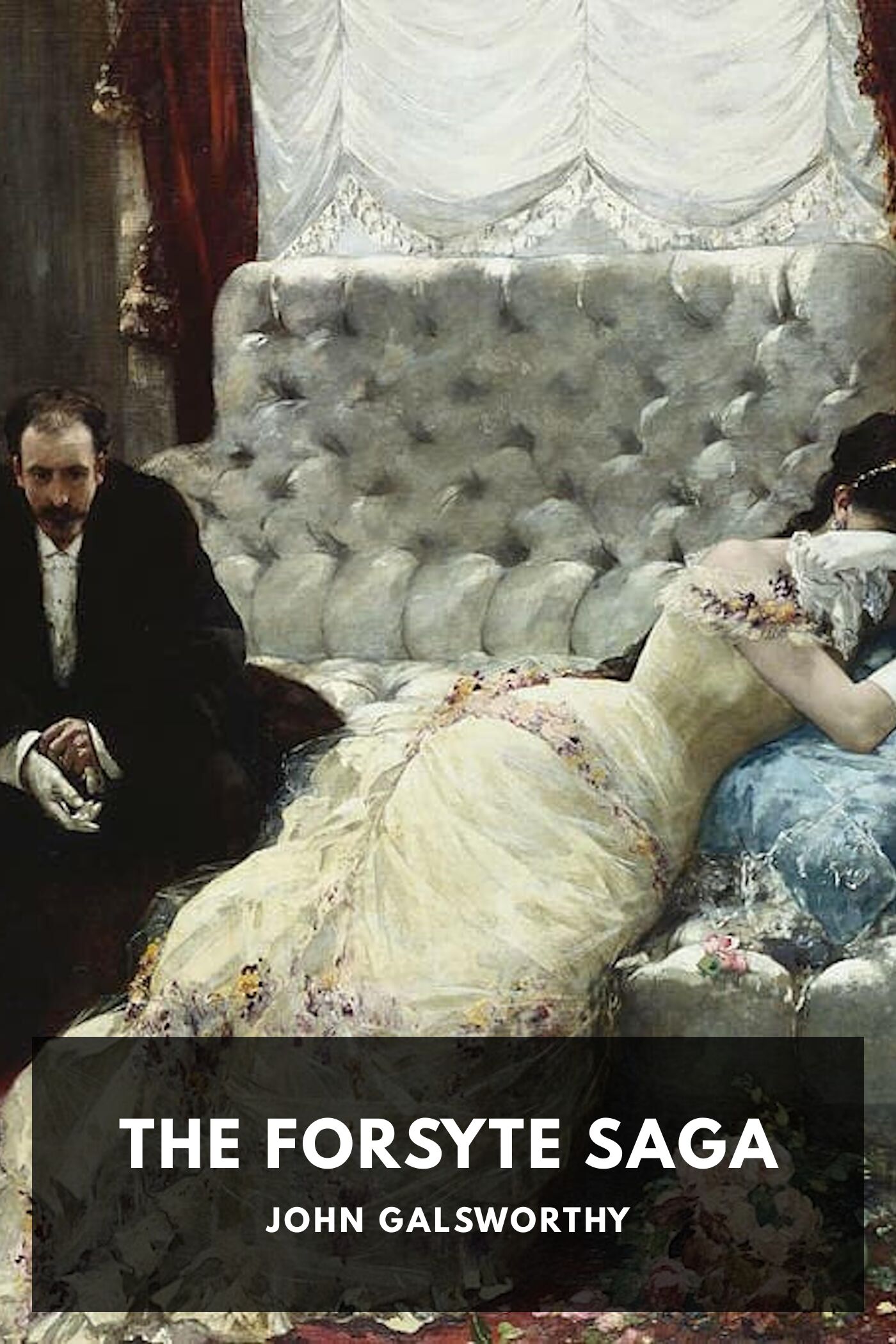
About this book
Between 1906 and 1921 John Galsworthy published three novels chronicling the Forsyte family, a fictional upper-middle class family at the end of the Victorian era: The Man of Property , In Chancery , and To Let . In 1922 Galsworthy wrote two interconnecting short stories to bind the three novels together and published the whole as The Forsyte Saga .
While the novels follow the Forsyte family at large, the action centers around Soames Forsyte—the scion of a nouveau-riche London tea merchant—his wife Irene, and their unhappy marriage. Soames and his sprawling family are portrayed as stereotypes of unhappy gilded-age wealth, their family having entered the industrial revolution poor farmers and emerged as wealthy bourgeoise. Their rise was powered by their capacity to acquire, won at the expense of their capacity for almost anything else.
Thematically, the saga focuses on the mores of the wealthy upper-middle class, which was still a newish feature in the class landscape of England at the time; duty, honor, and love; and the rapidly growing differences across generations occurring in a period of war and social change. The characters are complex and nuanced, and the situations they find themselves in—both of their own making, and of the making of society around them—provide a rich field for analyzing the close of the Victorian age, the dawn of the Edwardian age, and the societal frameworks that were forged in that frisson.
Galsworthy went on to win the Nobel Prize in Literature in 1932 for The Forsyte Saga , one of the rare occasions in which the Swedish Academy has awarded a prize for a specific work instead of for a lifetime of work.
Book Details
- Print length
- 1,164 pages
- Language
- English
- Publisher
- Standard Ebooks
- Publication date
- March 25, 2020
The Forsyte Saga
John GalsworthyMore from Fiction

Moby Dick
Herman Melville

A Room With a View
E. M. Forster

Crime and Punishment
Fyodor Dostoevsky

Alice’s Adventures in Wonderland
Lewis Carroll

The Count of Monte Cristo
Alexandre Dumas

Middlemarch
George Eliot

The Blue Castle
L. M. Montgomery

The Adventures of Sherlock Holmes
Arthur Conan Doyle

Jane Eyre
Charlotte Brontë

The Mysteries of Udolpho
Ann Radcliffe